Evaluating Practical Self-Defense for Everyday Adults
Practical self-defense is fundamentally about early hazard identification, decisive verbal boundary setting, and creating immediate avenues of physical escape rather than engaging in prolonged bouts. Many adult self-defense classes mistakenly focus on complex martial arts choreography that looks dramatic during demonstrations but collapses under intense adrenaline. When searching for reliable training, prioritize programs that emphasize pre-assault indicators, situational de-escalation, adrenal stress management, and simple, gross-motor reactions over intricate sport-based combinations.
Quality adult training begins by establishing the legal boundaries of justifiable physical force. In most states, physical resistance is legally defensible only when facing an imminent threat of bodily harm, and your objective must always be stopping the threat and disengaging immediately rather than trying to punish or incapacitate an assailant. A credible self-defense program teaches students how to document aggressive behavior, use natural non-threatening stances that keep hands elevated, and project vocal authority to alert witnesses before physical contact ever occurs.
Realistic training balances mental boundary work with authentic physical resistance. Drilling techniques against a completely passive partner helps you learn basic mechanics, but without dynamic, unscripted pushback, genuine muscle memory fails to form when panic hits. The most dependable training facilities introduce progressive pressure carefully, allowing adult beginners to test functional escapes against an instructor or classmate who is actively attempting to grip their clothing, block their retreat, or pin their shoulders.
Women's Defense Strategies Against Larger Physical Opponents
Programs developed specifically for women must realistically account for severe differences in physical size, muscular strength, and overall mass. In assault scenarios, an aggressor rarely approaches like a squared-off boxer; violence directed at women typically manifests as sudden grabs, pinned arms, cornering against walls, or violent takedowns to the pavement. Specialized defense classes for women bypass direct strength-against-strength confrontations, relying instead on structural leverage, off-balancing, and attacking vulnerable anatomical points to produce a fast sprint window.
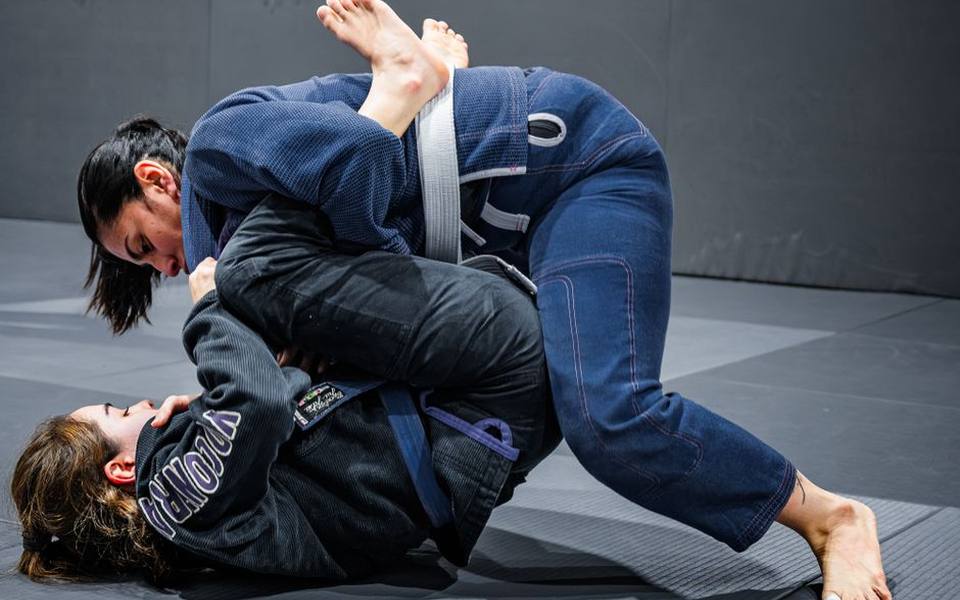
Ground survival tactics are an indispensable cornerstone of any female self-defense curriculum. If forced to the floor, an untrained defender often exhausts their stamina trying to shove a heavy torso away with isolated arm strength. Effective programs demonstrate how to build skeletal frames using the forearms and shins, use explosive hip bridges to displace weight, and slide the legs through to create defensive barriers. Understanding these body mechanics allows smaller practitioners to break dangerous wrist pins, protect vital organs, and scramble back to an upright stance within seconds.
Vocal assertiveness and psychological boundary work are just as essential as physical techniques. Societal pressure often conditions women to remain polite, defuse tension with compliance, and avoid causing public scenes—instincts that predatory individuals actively exploit when testing target boundaries. Instructors run specialized drills that condition students to break freeze responses by shouting firm, unambiguous commands like 'back away' or 'leave me alone' while advancing their defensive posture, which instantly signals resistance and alerts nearby bystanders.
Navigating High-Density Metro Environments and Transit Systems
Living or working in a densely packed metropolitan center creates unique physical constraints that open-floor martial arts academies rarely duplicate. Daily commuters traversing crowded train platforms, cramped stairwells, and crowded sidewalks face safety challenges where backing away in a straight line is structurally impossible. When searching for self-defense classes in NYC or similar urban hubs, look for workshops that specifically address enclosed spaces, blind architectural turns, low-light stairwells, and moving transit cars.
Urban defensive tactics prioritize proactive transit habits over physical altercations. Simple spatial awareness—such as keeping your back against a solid subway pillar, identifying train car emergency exits upon boarding, and avoiding distracted phone scrolling with both headphones in—vastly reduces vulnerability. In states with high population density, such as the 2,079 martial arts schools in New York, premier personal safety academies routinely stage realistic drills covering subway bench grabs, wall pins, and bag-snatch resistance.
Legal considerations regarding defensive tools are especially rigid within high-density municipal boundaries. Discharging a civilian pepper spray canister inside an enclosed subway carriage can easily incapacitate innocent commuters alongside an attacker, which can lead to severe criminal citations or personal liability depending on local statutes. Quality city workshops teach practitioners how to deploy localized defensive devices, such as focused handheld flashlights or loud personal safety sirens, while teaching compact elbow and knee strikes that function smoothly in tight commuter crowds.
Teen Self-Defense, Campus Readiness, and SafeSport Verification
Adolescents face an intersection of social pressures, including schoolyard bullying, digital harassment, and the transition toward living independently on college campuses. Training tailored for teenagers must establish clear separations between everyday peer disputes and dangerous predatory situations, giving youth the discernment to resolve petty conflicts verbally while maintaining zero tolerance for physical violence. Practical adolescent programs focus heavily on boundary reinforcement, helping teens project self-confidence through posture, voice control, and assertive eye contact.
When enrolling children or looking into family martial arts programs, thorough institutional safety vetting is mandatory. High-level academies increasingly adopt Safe Sport certification standards, ensuring all coaches, staff members, and volunteers undergo thorough background screenings and complete formal athlete safety training. SafeSport protocols prohibit private, unmonitored one-on-one sessions behind closed doors, creating a transparent community where younger students can build defensive skills free from harassment, emotional mistreatment, or institutional exploitation.
Preparing older teenagers for independent campus life involves addressing environmental risk assessment rather than teaching hand-to-hand combat alone. High-risk collegiate settings like poorly monitored dorm parties, unfamiliar apartment complexes, and unlit campus paths demand practical protocols around buddy systems, drink safety, and recognizing early intoxication dangers. Combining physical release mechanics with realistic discussions around consent boundaries and social coercion equips young adults with the mental maturity required to keep themselves and their peers safe.
Active Threat Preparedness and Mass Casualty Response
Rising concerns over public safety have led many businesses, educational centers, and private citizens to enroll in formal active shooter response training. Unlike standard one-on-one personal defense classes, an active shooter event involves an armed assailant attempting to cause widespread destruction within a localized crowd. Training in this critical domain bypasses conventional martial arts techniques entirely, emphasizing environmental triage, rapid evacuation mechanics, and fast physical fortification.
The gold standard for civilian survival courses centers around the Run-Hide-Fight methodology developed by safety professionals. Running remains the primary goal: mapping out secondary exits, leaving bulky belongings behind, and exiting the danger zone with empty hands raised high to avoid misidentification by responding law enforcement. If escape routes are completely compromised, students practice lockdown procedures, learning how to brace commercial doors with heavy belts, wedge heavy furniture against entrance frames, and eliminate interior shadows.
Physical resistance against an active shooter is strictly taught as a desperate, collective measure when death is otherwise certain. Modern civilian defense seminars train participants how to stage coordinated ambushes from doorway blind spots, using heavy workplace items like fire extinguishers or metal chairs to violently disrupt the shooter's aim. Instructors emphasize that if you are forced to engage, your sole technical focus must be seizing and redirecting the weapon's barrel toward the floor while your peers use collective weight to pin the attacker.
Evaluating Personal Protection Dogs Within a Home Defense Plan
Many homeowners explore options beyond personal martial training, considering a personal protection training dog to guard their family and residential perimeter. While online videos frequently showcase impressive working breeds lunging at padded bite suits, owning a true personal protection canine involves an intense, daily operational commitment. These animals are not ordinary family pets; they represent high-drive working dogs requiring rigorous ongoing obedience maintenance, extensive public desensitization, and strong handling skills.
Prospective buyers must recognize the difference between a natural watchdog that barks when a doorbell rings and a certified protection canine trained to bite on command. Professionally trained protection dogs require deep nerve stability, impeccable impulse control, and the clear cognitive ability to distinguish between a delivery driver carrying a package and an aggressive home intruder. Without hours of weekly handling and regular refresher sessions with qualified decoys, a powerful protection animal risks becoming an unpredictable domestic liability.
A working canine functions best as an early alert and intimidation perimeter rather than an autonomous security solution. The dog's acute auditory and olfactory senses can notify you of boundary breaches long before home alarm sensors register a broken window, granting you valuable minutes to secure family members, arm personal safety equipment, or contact local authorities. Relying solely on an animal without developing your own physical defensive habits and home security structure leaves critical gaps in your overall family defense plan.
Online Instruction Versus Hands-On Partner Resistance
The explosion of remote training platforms has led many to question whether online self-defense classes offer genuine protective utility. Online coursework can be remarkably effective for mastering foundational theory, absorbing legal frameworks, and learning situational awareness habits. Studying video dissections of common street ambushes, analyzing body language cues, and planning residential security layouts can all be achieved successfully from a laptop without spending hundreds on gym memberships.
Despite these cognitive benefits, remote instruction has undeniable physical boundaries when it comes to developing kinetic muscle memory under terror. It is impossible to develop functional defense against an aggressive, heavyweight grapple simply by mimicking body mechanics in an empty bedroom. Real assaults produce an intense adrenal surge that causes tunnel vision, rapid breathing, and sudden loss of fine motor coordination; building resilience to that stress requires repeatedly feeling real human weight and sudden resistance.
If geographic isolation or an erratic work schedule limits you to online study, treat digital courses as an introductory or supplementary tool. Recruit a dependable training partner to physically rehearse wrist breaks, guard recovery, and vocal drills at gradually increasing resistance levels. To validate your timing and ensure your techniques hold up under realistic contact, schedule occasional visits to local instructional workshops or attend multi-day regional defense seminars.
Physical Conditioning and the Truth Behind Targeted Fat Loss
Many adults choose to step onto the mats looking for a rigorous workout that builds functional fitness alongside personal safety skills. During initial consultations, students often ask instructors how to lose only stomach fat or trim stubborn lower body fat through intense striking routines. It is essential to understand that spot reduction is an anatomical impossibility. The human body burns systemic fat through a sustained caloric deficit, utilizing energy stores determined by genetics, hormone balance, and overall energy balance rather than the specific limb being moved.
While you cannot force your metabolism to burn only belly fat during self-defense drills, martial conditioning ranks among the most calorically intensive activities you can undertake. Training routines involve rapid interval bursts, striking heavy pads, moving off the floor, and full-body stabilization that burn massive amounts of energy. Finding martial arts schools with fat loss programs can provide the ideal blend of high-intensity functional conditioning and resistance work, boosting cardiovascular health and raising your resting metabolic rate.
The rotational torque required to throw heavy punches, fire kicks, and hip-escape along the canvas actively develops your entire abdominal wall—including the deep transverse obliques and lower back stabilizers. Over consistent months of mat time, the combination of high caloric burn and dense core muscle activation pulls away both visceral and subcutaneous fat, revealing a tighter, more athletic torso. Pairing regular classes with structured nutrition will consistently reduce lower body and midsection fat as a natural consequence of building total-body athletic performance.
Core Combat Systems That Translate Under Extreme Stress
Not all martial disciplines yield equal dividends when dealing with violent, unpredictable street altercations. Traditional arts centered around non-contact sparring, pre-arranged forms, or artistic high kicks struggle against sudden, close-range ambushes where aggressive attackers close distance immediately. Modern self-defense leans heavily on practical combat sports that validate every technique through unscripted, full-contact pressure testing against fully resisting peers during weekly classes.

For close-quarters survival and escaping dangerous positions on the ground, joining a dedicated Brazilian Jiu-Jitsu program is widely regarded as one of the most practical investments a smaller individual can make. Jiu-Jitsu teaches students how to stay composed when pinned underneath an opponent, construct frames that absorb strikes, and utilize chokes or joint submissions that neutralize an attacker regardless of size. Pairing ground grappling with the timing and distance management taught in beginner kickboxing classes develops a comprehensive defensive foundation.
Rather than memorizing dozens of niche responses for every conceivable scenario, high-percentage self-defense relies on mastering a tight collection of proven fundamentals. An explosive low kick to an attacker's shin, a tight horizontal elbow in close contact, and a clean hip-escape to stand up represent high-percentage options that work reliably under fear. When sudden violence erupts, cognitive processing degrades instantly; keeping your technical toolset minimal ensures your body reacts decisively without freezing in hesitation.
How to Audit a Defense Academy Before Committing
Walking into a martial arts school for the first time can feel overwhelming, but auditing the environment beforehand protects your safety, time, and budget. Any reputable academy happily invites prospective students to view an intermediate class or take an introductory trial class without subjecting them to aggressive sales tactics. Pay close attention to how students interact: the atmosphere should feature mutual respect, clean sanitation habits on the mats, and controlled pacing rather than dangerous ego-driven sparring.
Take time to interview head instructors regarding their background, certifications, and teaching philosophies. Clarify whether their material has been refined for everyday adults and women, or if their curriculum is purely geared toward young competitive tournament fighters. Be cautious of instructors who claim their fighting style is 'too dangerous to practice with resistance'—this is a classic sign of untested technique. The most capable coaches clearly articulate the anatomical mechanics behind every move and welcome critical questions about practical real-world application.
Read membership contracts carefully before signing multi-month direct-debit commitments. Tuition structures and cancellation terms vary widely across the country, ranging from flexible monthly billing to strict twelve-month agreements that impose hefty cancellation penalties. With more than 20,366 verified listings across top states on MartialArtsAtlas, everyday adults have the freedom to compare programs, evaluate user feedback, and select an academy that matches their personal safety goals.
Published 2026-09-21 · reviewed with each rebuild, last September 2026.
Find martial arts schools near you
The directory lists 32,877 martial arts schools by state and city — pick your state or use the “Near me” button in the header.
More guides
-
 Owning
Establishing a Proper Heavy Bag Routine and Striking Technique at Home
-
 Safety
Brazilian Jiu-Jitsu for Beginners: Tips, Fundamentals, and Mat Health
-
 Buying
Finding the Right Fit: A Guide to Sizing Your Jiu-Jitsu Uniform and Cross-Training Gear
-
 Money
MoneyHow Much Do Martial Arts Classes Cost? Membership Fees Breakdown
-
 Owning
What Is Mixed Martial Arts? Beginner Overview and Training Guide
-
 Owning
The History, Origins, and Physical Demands of Brazilian Jiu-Jitsu
-
 Owning
Traditional Martial Arts Guide: Understanding Wushu, Silat, and Naginata
-
 Owning
Understanding Mixed Martial Arts for Beginners
-
 Safety
How to Wrap Your Hands for Boxing: Step-by-Step Wrist and Knuckle Protection Guide
-
 Buying
Best Jiu-Jitsu Gis and Apparel: Complete Buyer's Guide and Sizing Chart
-
 Buying
BJJ vs Judo vs Wrestling vs No-Gi: Which Grappling Art Is Right for You?
-
 Buying
How to Choose the Best Jiu-Jitsu and MMA Gym Near You
-
 Owning
Brazilian Jiu-Jitsu for Beginners: Rules, Belt Ranks, and Mat Training
-
 Buying
Kickboxing Classes & Cardio Fitness Workouts Guide
-
 Owning
Martial Arts Belt Ranking Systems: Progression, Orders, and Displays
-
 Buying
Jeet Kune Do: History, Philosophy, and Modern Training Guide
-
 Buying
BJJ Gis and Uniforms Buyer's Guide: Brands, Fit, and Care
-
 Buying
Gracie Jiu-Jitsu Lineages, Academy Networks, and Training Philosophies
-
 Buying
10th Planet Jiu-Jitsu: Complete Guide to the No-Gi System and Academies
-
 Safety
Tai Chi Classes for Seniors: Health Benefits, Styles, and Practice Guide
-
 Owning
Heavy Bag and Boxing Workouts: Home Setup, Gear Selection, and Training Guide
-
 Buying
Adult Karate and Taekwondo Classes: Getting Started and Gi Sizing
-
 Owning
IBJJF Tournaments and Competition Guide: Databases, Rules, and Events
-
 Safety
Custom vs. Boil-and-Bite Mouthguards: Complete Selection and Fitting Guide
-
 Safety
Women's and Adult Self-Defense Training Guide: Techniques, Classes, and Systems
-
 Owning
Traditional Chinese Martial Arts: Shaolin, Wing Chun, Jeet Kune Do, and Gear Guide
-
 Buying
Adult Martial Arts Guide: Choosing the Right Style, Gym, and Training Class
-
 Buying
Filipino Martial Arts, Kenpo, Aikido, and HEMA: Comparing Traditional Combat Styles
-
 Owning
Heavy Bag Workout Guide: Routines, Drills, and Training for Cardio and Weight Loss
-
 Buying
Muay Thai and Cardio Kickboxing Classes: Training, Techniques, and Fitness Programs
-
 Buying
BJJ Gis, Rash Guards, and Apparel: How to Choose, Size, and Care for Jiu-Jitsu Gear
-
 Owning
Martial Arts Belts and Ranks: Belt Order, Taping, and Display Racks Guide
-
 Safety
Martial Arts Conditioning, High-Kick Mobility, and Protective Gear Guide
-
 Buying
Kids and Toddler Martial Arts: Complete Guide to Classes, Camps, and Family Dojos
-
 Owning
How to Hang a Heavy Bag: Ceiling and Wall Mounting Installation Guide
-
 Buying
Brazilian Jiu-Jitsu Schools, Academies, and Lineages: A Complete Guide
-
 Buying
Martial Arts Gyms, Fitness Studios, and Dojos Directory Guide
-
 Buying
Traditional Martial Arts Styles and Specialized Disciplines Guide
-
 Owning
BJJ and Martial Arts Gi Selection, Sizing, and Equipment Care Guide